Categories
Uncategorized

Medical Equipment Radio Frequency Interference

Is Medical Equipment Radio Frequency Interference Present in Hospitals & Clinics?


Medical Equipment Radio Frequency Interference is similar to that which effects all electronic devices. Medical devices and equipment are often associated with and powered and controlled by electronic circuits. These instruments are constructed from the same electronic chips and circuits that power our TV sets, stereo systems, microwave ovens and cell phones. In some instances we all have  observed that  EMI/RFI  electrical interference effects normal electronics devices. (Turn on your AM radio next to the microwave oven).  The same sort of RFI problems cause   Medical Equipment Radio Frequency Interference in hospitals, clinics and other medical settings.

Medical Equipment Radio Frequency Interference Logo
Safety and Medical Equipment Radio Frequency Interference Interference are Related

This indeed is the case. Reports have noted that RFI,  radio frequency interference, shows up in all sorts of  medical devices. The interference ranges from just an annoyance to hampering operations.   At worst case it might become potentially lethal to providers or patients,  depending upon the circumstances and equipment involved.

What Standards Define Medical Equipment Radio Frequency Interference?


There is an intentional  standard called the 1993 IEC 60601-1-2. It sets out a standard of three volts/meter for emissions in the 26-1000 Megahertz range.   This means that sensitive life sustaining instruments need to be shielded and able to operate safely in fields up to this value.  Medical devices  that are deemed to be “non-life supporting”,  require EMI/RFI testing only at these three specific frequencies: 27.12, 40.68 and 915.0 Megahertz.

Protecting Medical Equipment from Interference


Medical instrument providers are mandated to protect their medical equipment from all harmful Medical Equipment Radio Frequency Interference is present in and possibly affects the equipment they manufacture. Medical personnel  observe  on many occasions, that interference does occur.  Quite often this interference comes from  cell phones and pagers used by  medical personnel and medical first aid responders.  RFI/EMI  emanates from everyday sources such as smart-meters, cell phone towers, Wi-Fi routers, as well as public safety transmitters and, not last but least, other medical equipment. Even poorly shielded microwave ovens  emit troublesome radiation.

Preventing Medical Equipment Radio Frequency Interference


Medical device manufacturers shield and protect most of theses devices if they are properly designed at the outset. Current  noisy electrical environments include the  “Internet of Things”, electronic security alarms, radar sensors, video cameras, home & professional  internet routers,  or personal medical devices worn on wrist bands.  We all are attached to our  cellular phones.  We expect that RFI/EMI  interference with medical devices will be a continuing problem.  Electromagnetic interference should be addressed both in the design, manufacture and the use of these devices in the medical setting.

Vigilance Needs to be the Normal Attitude in Safety


Finding Medical Equipment Radio Frequency Interference within  medical facilities needs to be a high priority.  Medical equipment RFI is easily tested by professionals using quality electromagnetic field strength meters and spectrum analyzers. These test instruments  pinpoint the exact location of the offending equipment and the  strength of  interfering EMI fields.  They accurately  measure medical equipment radio interference fields and determine their compliance with the US and International standards referenced above.

If you have any concerns, questions or comments, please either leave us a message or comment below. We will try to answer any of your questions or concerns.


Categories
Uncategorized

How Does Nitrogen Contamination of Water Occur?

Is  Nitrogen Contamination of Water Increasing?


Let’s take a look at the probable causes of the Nitrogen Contamination of Water.  Over the decades, the use of  Nitrogen fertilizer to assist agricultural production has greatly accelerated. Since  the late 1940’s , consumption of fertilizers for agricultural use has increased about five hundred  percent (500%) . Some of this increase has been due to over-application of the suggested amounts which are needed to improve fruit & vegetable production. These excess amounts have resulted in runoffs of these chemicals and have found their way into our ground water, rivers, streams, reservoirs, and lakes. Many people have observed these effects as the green algae bloom which is found in lakes, stagnant bodies of water, and even shows up in satellite photos. Upon inspection, significant plumes of algae can be easily observed from space flowing into the Gulf of Mexico.

Rural Wells can add to the Nitrogen Contamination of Water
The Nitrogen Contamination of Water in Rural Wells can be a Problem

This increase in Nitrogen fertilizers applied to the land,  ultimately can lead to the contamination of our drinking water sources. When Nitrogen breaks down chemically it ends up as Nitrates which exist in a vast majority of our  rivers, lakes, and underground water sources, primarily in agricultural areas. Municipal water utilities are regulated by the US Environmental Protection Agency (EPA) and are mandated to have no more than 10mg/liter (milligrams/liter) of nitrate/nitrogen concentration, which is considered to be an acceptable limit. Rural populations quite often obtain most of their water from underground wells, and these water sources are not subject to federal or local governmental oversight.

What  Nitrogen Levels  are Acceptable?


The minimum concentration levels are a definitive way of measuring the nitrogen contamination of water. A Minimum Concentration Level (MCL) of 10 mg/L (10 miligrams per liter)  is sometimes  exceeded in municipal water treatment, because of the excessive costs to remove it. In the main, however, it will typically be in the range of (2-10 mg/L). In rural environments, and due to the water runoff from agricultural lands, the level may end up being 3-10 times higher than the governmental specified Minimum Concentration Level.

Health Studies Point to Medical Conditions Related to Nitrogen Compounds


Many health studies have pointed to the fact that increased Nitrogen/Nitrate consumption may be contributing to a variety of very unfavorable medical conditions including diabetes, thyroid problems and possibly a higher risk for cancerous diseases. Persons who are concerned about these negative effects should seek out reliable medical scientific studies reflecting the problems with excess Nitrates in our food and drinking water supplies. You might want to check with your local water system provider to see what Nitrogen levels they measure and consider acceptable.

How can I Determine the Levels of Nitrogen/Nitrates in My Water Supply?


If your are on a municipal water system,  contact them and see what testing they have done, and how you might be able to see the results. Some municipalities publish this information in  newsletters or annual summaries  or have it available on-line. If you are unsure of your personal exposure to Nitrogen/Nitrates and you are on a well-based water source, or other non-municipal water system, you may wish to avail yourself of water testing kits  that are commercially available and will help you to identify elevated levels of Nitrogen/Nitrates in your drinking water.

How Does the  Nitrogen that I  Ingest Affect My Well Being?


How does the nitrogen contamination of water affect your body? It should  be noted, that the total of all Nitrogen/Nitrates in your body will be the sum total of these chemicals  found in your drinking water,  in the food that you eat, and in in some types of prescription drugs.  Minimizing any, or all of these sources may improve your health and wellness.

Categories
Uncategorized

LED Lighting Advantage for Home and Business

Energy Efficiency and the LED Lighting Advantage


Residential home lighting has become very familiar and routine in our modern age. The LED Lighting advantage  has recently become  more of a factor in modern home lighting. As the Gas Lights faded, and our world became lighted by electricity, our societies energy usage grew and grew.  In order to provide electric light, our electric utilities need to generate more and more electric power. Using various lighting methods, i.e., LED’s,  incandescent, Tungsten, Florescent and others, we can generate lumens. We use lumens to measure  the” real visible light output” that illuminates the area in the region of a light source. So in general, it may be said that what we pay for in our electric bill, for lighting, is  lumens. Let’s examine what the costs are for lumens and what efficiencies we might expect from LED based lighting devices.

Vintage Gas Light Fixture

Early developments in lighting produced the Edison Bulb which was his invention for generating light from electrical current. After years of trial and error , Edison finally found the ideal “element” tungsten for generating electricity inside a bulb that contains  inert gases inside. Early on Edison was in favor of using direct current (DC) to light homes and factories. Another earlier electrical experimenter Nikola Tesla, was an advocate of using alternating AC current for powering homes and factories.  Eventually after years of competition, Tesla won the battle, due to the fact that AC electricity was easier and less costly to distribute using both very large and smaller  AC transformers.

Tungsten bulbs produce a very nice type of light which emits a  wide spectrum of white light. The more power we put into the light, the higher the electrical power usage and the more lumens we get out; but unfortunately  generate more than lumens.  We also get a lot of  energy in the form of heat!  This extra heat output results in  additional costs.  For instance in summer, if we run air conditioning , this additional heat generated will tend to make a room warmer.  We need to consider the fact  that  we are paying for ALL the electrical energy going into the light bulb, in the form of both heat and light. A typical 100 watt incandescent light bulb will generate about 1600 lumens.   Some more efficient  LED lights can also produce a nice warm type of white light that is similar to incandescent lighting.

What does it Cost To Run a 100 Watt Bulb all Year Long?


For example let’s assume that you are paying 20 cents/kilowatt hour  for your electricity.  Computing  these costs for a year gives us:

Watts/Day –   (24hours ) x (100  Watts/day)   is equal to  (2400 watts-hours/day x 365 days/year) x (1kilowatt/1000 watts) = 876 kilowatts/year.  At the assumed  cost of $0.20 (twenty cents/kilowatt-hour) your yearly cost will be $175.20. At 10 cents per kilowatt-hour your costs will be $87.60 per year. Costs for electricity in your area will of course vary, and quite often you may be charged different costs/ kilowatt hour, depending on how much you use per month.  These blocks are sometimes called “tiers”.  Tiers typically result in much higher costs for energy, the more energy that you consume in one month.  In order to calculate your average cost of electricity per kilowatt,  you must average the amount and cost for each tier each month.  It is not uncommon in parts of the USA to see tier charges of over 50 cents per kilowatt hour!
The LED Lighting Advantage for Your Home


LED lighting can put out the same number of lumens as a 100 watt incandescent bulb, and  at a much lower cost. To get our typical 1600 lumens, we can use  an energy efficient LED type bulb.  According to the US Energy Department, LED lights with the ‘ENERGY STAR’ rating, use at least 75% less energy, and last at least 25 times longer than incandescent bulbs. So if we use these facts in the example above, our yearly costs for a 100 watt LED bulb/year will be about $45.80 and $21.90 respectfully. A great savings!

How is the LED Lighting Advantage Achieved?


LED Lighting Advantage (Ganged LED Cells)

LED’s came into being in the 1960’s and were used at first for indicator lights. They are made from semiconductor materials similar to  transistors & diodes, and use a low power DC Voltage source. LED’s have no filaments or glass bulbs inside, but instead use  semiconductor chips which emit visible light when they are energized by an electric supply circuit. The color of the LED varies depending upon the type of chemicals used in the bulb. Early lights were red, green and blue in color. When these RGB colors  are combined,  or mixed a light very similar to white light is produced.  The  resulting  light can be easily focused with lenses or diffusers.  As semiconductor technology advanced over time, the cost of these LED lights continued to tumble.  Very cost effective LED lighting solutions have  been achieved today.  Using LED technology, a home or business owner can experience the LED lighting advantage , by combining good lighting and  energy efficiency, while  typically experiencing reduction in the cost of energy.

Categories
Uncategorized

Radon Gas Exposure in Your Environment

Places Where Radon Gas Exposure is Found?


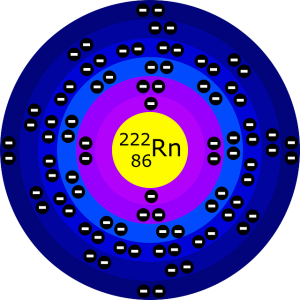
Artists Pictorial Rendering of Radon 222 Atomic Structure

If you reside in North America ( United States or Canada),  you should be aware that Radon Gas Exposure is very common and found in the environment of all national regions.  Radon is a noble gas that is formed by the decay of Uranium, a naturally occurring element found in the soil and in water.  Although it is found in water, Radon will most likely affect humans in its gaseous  form in the air we breathe. Only two gaseous forms are found in elevated concentrations in our  human environment.  These are  Radon-222, and Radon-220:Radon-220 is seen to be most prevalent in our human environments.

Radon is colorless and  odorless, not subject to detection by our human senses.  It is the heaviest known gas, and is about nine times heavier than Air (approx. 20% oxygen & 80%  nitrogen).  It is only one atom, instead of two like O2 (oxygen) and N2 (Nitrogen , and is able to go through common barriers such as clothing, paper, low-density plastic, wood siding, and most insulation products. It is also able to penetrate mortar, concrete blocks and sheet rock which is commonly used in the building construction industry.

How does Radon Gas Exposure Occur and get into our environment?


Radon is not manufactured commercially.  Radon Gas Exposure occurs because Radon Gas is produced from the radioactive decay of Uranium found in rocks, rocky formations and most soil.  It is commonly found in ground water, building materials, or the ground itself.  Usually the most severe inhalation problems occur in Radon rich gaseous environments.  It can be found in basement areas, caves, mines, enclosed spaces adjacent to closed areas exposed to the earth, or typically in public baths and spas.

What is the level of  Radon Gas Exposure deemed to be potentially harmful to humans, and its concentration?


The U.S. EPA and U.S. Public Heath Service, have given the estimate that at least 20,000 lung cancer deaths per year are caused by  Radon gas exposure. It has become the second leading cause of lung cancer in the USA.  About one-third of homes in the USA  exhibit radon levels over 4pCi/L (4 picocuries/liter).  This is amount  is called the Radon gas exposure “Action or Reference level” of concern to inhabitants and home owners.

How can you make Accurate Measurements of  Radon Gas Exposure Levels in your home and other structures?


In general, electronic Radon gas detectors work by detecting particles that are being thrown off by the natural decay of Radon gas in your environment and in close proximity to the measuring detector. These particles are called “Alpha particles” and are counted as the result of being detected by a photo diode in the sensor which can detect the presence of Alpha particles. The electronics in the device measures the alpha particle activity, and filters out the extraneous “noise” in the environment of the sensor. If the detector is properly designed it will hold its calibration over a long period of time. Electronic measurement devices are calibrated  when they are manufactured. Each detector is compared to a “standard” and is adjusted to measure Radon levels within the  accepted tolerance of the device in order to insure accurate measurements. Re-calibration is suggested by the manufacturer, and the longer that period of the time is the better, since re-calibration will usually involve an ongoing expense.  The electronic Radon detector has an advantage of presenting an accurate readout value(s) over a period of time. It can be re-used and placed in all rooms of the home or business and give an accurate picture of radon levels throughout the year. Variation of radon levels are to be expected, due to climatic conditions and local variations in temperature, dust, airflow and moisture levels.  Evaluation of radon levels should be averaged over many measurements and throughout the year.

The lowest cost test for Radon gas exposure in the home can be performed by a single-use test device. These devices need to be in place for some time in order to obtain a useful radon average reading. Unfortunately they are useful only in one certain area of your home, such as a particular room or basement, and they need to be physically mailed to a laboratory for analysis of the radon levels that they measured. They are a “one-time” measurement solution, and are not costly, ($25 or less) but to measure radon gas exposure in an entire building accurately, it might mean obtaining multiple detector strips and placing them throughout your home or office.


Categories
Uncategorized

How Pesticides Influence Water Quality

How do you learn about pesticides and how pesticides influence water quality?   Many local water agencies will have information  relating to local water testing results and will be able to provide information and brochures relating to toxic chemicals.   Surprisingly, a number of local agencies are listed in the “impaired” category by the Environmental Protection Agency (EPA) .  For example, in California, at least 85 water bodies are listed in this impaired category.

What Type of Pesticides are Found in Local Water Sources?


Two types of pesticides that are very commonly used in residential areas are called chlorpyrifos (Dursban) and diazinon.  These two pesticides often occur in local storm water runoffs.  Unfortunately, their levels of concentration are not diminished by passing through local water treatment plants.  Often the concentrations of these chemicals is high enough to effect  fundamental organisms at the base of the food chain.

Has the EPA been Able Reduce Pesticide Use?


In the year 2000, The EPA announced an agreement, with some pesticide manufacturers, that significantly reduced most products containing chlorpyrifos (Dursban) from sale to retail customers and most commercial uses of the chemical overall.  The EPA had discovered through research that chlorpyrifos was potentially more harmful to infants, children and women.

What Pesticides are  in Our Environment Causing Problems?

Local Application of Pesticides by Spraying Fields

Organophosphates are called “broad-spectrum pesticides”, and can compromise the nervous systems of many organisms.  They are used to kill a wide variety of pests and insects, including: ants, flees, aphids, spiders, and wasps.  They can be also highly toxic to honeybees and birds, and other insects and mammals. Some researchers have found that pesticide residues can be detected on a number of foods purchased at grocery stores.

How are Pesticides Introduced into Our Environment?


Many pesticides are introduced into our ground water and environment by the continued use of these chemicals by residents and home gardeners as well as by pest control professionals.  They are applied around home structures, in schools and businesses as well.  Many problems with these pesticides can be traced back to the application, in excess, of these chemicals in urban settings.  Many of the excess concentrations of these chemicals take place because of the sheer volume of use and the inadvertent release into the local environment.

What Disposal Methods Should Be Use for Chlorpyrifos or Diazinon Around Your Home or Business?

If you discover leftover and unwanted chemicals in your home, do not pour them down any drain, gutter or around your residence.  Also please do not dispose of these chemicals in the trash.  Instead please find the location of a nearby  hazardous waste facility, and take them to that location.  For a reference on these locations, you can telephone 1-800-CLEANUP.ORG.

What are the Proper Practices to Improve the Health of Our Rivers, Creeks, Streams and Bays?

Attempt to implement alternative strategies for your garden and try control methods that do not involve the use of  chemicals or pesticides.  This can be done by following suggestions and natural treatments such as those found in the publication,  Our Water, One World fact sheets.  Controlling pests can be accomplished in a variety of ways.  This can be accomplished by introducing pest predators into the environment.  Oils, soaps and other biological controls can be applied as well.   Often some alternative pesticides are available.

 Investigate the Use of Harmful Chemicals and Pesticides


If you are responsible for a home garden, lawn and other plants in the environment,  take a look at how the use of pesticides. These pesticides influence water quality. Read up on alternative methods for pest control and learn how to minimize the use of chemical pesticides for this purpose.  Check with your local water agency and find out what testing, if any, has been done on your local water sources.  If these tests reveal high residues, get involved in your local community and  suggest programs that might mitigate and reduce these chemical concentrations.

Federal Government Defines Concentrations & Exposure Levels of Pesticides


The Safe Drinking Water Act  (SDWA)  requires that the  EPA establish Maximum Contaminate Levels (MCL)  to insure that human health is protected.  MCL is the highest level of concentration that is allowed in public water supplies.   The MCL makes certain assumptions: that a person lives 70 years, weighs 70 kilograms, and drinks up to two contaminated quarts of water each day.  MCL’s are subject to change, but are legally enforceable limits which must not be exceeded.

Do You Know about the Concentrations of Pesticides and How These Pesticides Influence Your Water Quality?

At present, public water utilities are required by the SWDA  to measure levels of contaminates in the water. They are required to collect at least four samples of tap water for analysis of any possible contamination.   If the annual average contamination of these collected samples exceeds the MCL , consumers must be notified.  If these levels are excessive, the water utility must mitigate the problem by providing an alternate water source, or blend the current water source with clean water from a non-contaminated source.

 Acceptable Water Sources and EPA Water Guidelines


Pesticides influence water quality because contamination of water sources by these agents is measured in parts per billion (ppb).   Working to insure that the proper levels are addressed is the State Management Plan, which is overseen by the EPA.  It defines the responsibilities of  State agencies with regard to these standards.

How Many Types of Pesticides are in the Marketplace?


More than 50,000 pesticides have been registered with the US government since the FIFRA was enacted in the 1947.   This act was amended in 1988 and required that all pesticides in use before 1984 would be subject to evaluation by the EPA.  This act made it necessary to re-evaluate 1150 active ingredients in 45,000 formulations of products. The active ingredients were assigned into 612 chemical groups. These were further subdivided into groups called  A,B,C and D  based on the negative effects that these agents would have on food, water and human health.


Categories
Uncategorized

Do Green Energy Solutions = Green Energy Value?

Green Energy Value of  Electric Autos


What determines “Green Energy Value”.  Is it the use of some form of energy that might otherwise be lost? Or perhaps using energy sources that do not cause warming gas emissions? Maybe it is using solar panels to charge our cars.   For example, when a framer’s cows are flatulent they  produce Methane gas  (CH4) which can be used for any power source. Methane gas can be burned easily and will produce energy when it does. So, let’s pose a question regarding Electric Vehicles.  Where does the electricity come from that powers these cars?  You reply, ” It comes from charging the battery ”  which is of course correct, but need to examine  the source of the battery charge in order to find the original source of this energy.

Green Energy Value or a Just a Bad Choice?

Do Batteries = Green Energy Value?


Most batteries for cars charge via the local electric power provided at a charging-station or  your household 220 Volt connection.  OK you say, but how clean or efficient is that ?

When the battery is charged with AC power, it is converted into DC current so that it can charge your  electric car. As the charger functions, it creates additional heat and this heat represents lost energy in this process.  If you have a very good charger it will convert about 85% of your house electric energy into energy that your battery can use. Another way of saying this is that it will also loose 15% of the power put into the charger.

Do we get Green Energy Value using Lithium Batteries?


Lithium Ion Batteries are commonly used in electric road vehicles, and even used in powered skateboards.  These batteries are very useful because they contain a higher energy density than other types. Energy density is the amount of power capacity that you can get out of a battery per weight of the battery. Lithium Ion (Li-On) batteries are packaged together to develop higher current or voltage as a unit.  This denser packaging may cause problems when one or more cells develops a failure and thus a hazardous condition.  Ignition and burning of Li-On batteries causes fires all the time in vehicles, airplanes, skateboards, and  laptop computers.  This flammability results from manufacturing or design problems or from improper use of these batteries.  The cells in these batteries contain stored electrical energy which comes from their internal chemical reactions.  Discharging  Li-ion cells creates chemical energy that can be released through the combustion of their electrolytes.

Green Energy Value –  Is it Lost in the Cost of Disposal?


In addition to the use concerns, Li-On cells and other batteries present recycling issues. These batteries act like little chemical factories, and  they need to be disposed of and recycled in the proper manner (this is common of other battery types as well).  An electric vehicle contains  many hundreds of pounds of these cells when it is produced.   In order to keep green energy value, these batteries need to be recycled and/or properly disposed of.  Doing this is not cheap, and their  “end of life costs” should be considered as real and substantial cost of using “green vehicles”.  Improperly discarding of these energy sources can lead to more costs for the society as a whole, or the individual costs of disposal  in addition to the replacement costs for the vehicle involved.


Categories
Uncategorized

Even Small Amout of Lead in Water Supply Can be a Problem

How is Lead Introduced into my Water System?


Home Water Lead Contamination can be introduced into household drinking water in a number of ways. Pipes carrying water from the main distribution pipe (usually in the street) into the house can be contaminated with lead. Pipes  in the house can leach some lead into the water. If your home  uses copper piping, it may come from the lead solder joints that are used to seal the copper fittings. Lead may also be present in the interior pipes due to lead leaching from the pipe and its fittings.

How can I see if I have Lead in My Water Supply?

The only way to determine Home Water Lead Contamination in your residence, is to have it tested. The Environmental Protection Agency (EPA) recommends that you take action if the lead level exceeds 15 parts-per-billion (15.0 ppb). Please check with your local water utility or provider to see if they have ways to assist you in testing. If the feed pipe from the street is relatively free from lead contamination, and your interior water taps are at higher or unacceptable levels, then it may be assumed that the contamination is coming from your interior pipes. If your tests demonstrate higher levels, you can partially mitigate the problem by running the cold water faucet for several minutes before drinking it or using it for food preparation. Lead has a tendency to remain in the pipes, but this flushing will help to reduce the concentration so that if may be possible to use it safely.  Testing the levels under these circumstances will be helpful to make this determination.  Lead testing kits, and testing services are available from some utilities and also from private testing labs as well as commercial sources.

Lead Water Filter Improves Quality


Home Water Lead Contamination can be  mitigated somewhat by filtering to reduce lead levels.  The ability to remove the lead depends upon the process available in the filter, filter cost and efficiency and other factors.


Categories
Uncategorized

Facts Concerning Chlorine Water Treatment

What  Chemicals are used in Chlorine Water Treatment?


Chlorine Bleach is usually a diluted mixture of Chlorine and Water.   Another chemical solution of ammonia may be added to it. This combination may be used to create a substance called Chloramine which can be used as an anti-bacterial agent in the treatment of water. The usual combination of these substances used for the chemical treatment of water has the chemical name of  mono-Chloramine  with the chemical symbol of  NH2Cl.  A diagram of it looks like:  

Chemical Symbol

Often Chloramine is added to water in a water treatment plant to chemically treat the water and to reduce the harmful bacteria that may be present.  In the past, adding plain  Chlorine was normal practice in water treatment.   Tests revealed that Chloramine-treated water will keep the treating chemical active for a longer period of time, before it degrades in the treated water.

How much Chloramine is Too Much?


Some environmental groups are questioning the use of these treatments of water by the water utilities. For the same weight, Chloramine is less effective in killing bacteria than Chlorine is. To be effective the PH of the water should be about 7.0 or in the middle of the PH Scale. Some people want to remove the Chloramine from the water after it is processed and sent via pipes to our homes.  Filters have been devised to remove some of these chemicals.  Use of granular active carbon filters proves to be very effective in removing Chloromine as well as other chemical substances from water.  If, say for instance, the levels of Chloramine were to be 1-2 ppm (parts per million), then one of these active filters could reduce this level to about  0.1 ppm, a reduction of 10-20 times.

Can Boiling Water Remove Chloramine?


In addition to active filters, aeration (spraying air into the water) or exposure to sunlight will help reduce the concentration of Chloramine.  Unfortunately, boiling of water, distillation and reverse osmosis are not very effective for removal.  It is said that while Chloramine does not remove quite as many bacterial agents in our water, it seems to be less offensive in taste tests than Chlorine treated water.

Can I do my my own testing of my water in my home environment?


Yes water testing kits are available to allow the testing at home of drinking water, pool and spa water and other water containers. Water can be tested for pH (pools & spas) and for Nitrates, Nitrites & Free Chlorine using commercial water testing kits.  If public testing data is available the individual can make comparisons with  these  results.  Some water agencies make their chlorine water treatment and chemical concentration data available to the public. Be sure to inquire at your local agency for this information.


Categories
Uncategorized

Home Water Filters Remove Undesirable Chemicals and Bacteria

Diatomaceous Earth (DE)  Water Filters


Home water filters using diatomaceous earth (DE)  have been used extensively for over three quarters of a century.  The filter is based on the principal that fine earth particles placed on a small screen can inhibit the transmission of unwanted substances through the screen, and allow only much cleaner water to pass. These filters have been shown to produce safe drinking water, utilizing either vacuum based or pressure based systems. These DE home water filters have been shown to remove Giardia and Crptosoridum cysts in normal operation.  Flow rates for typical filters are not too high, averaging (0.2 to 2) gallons / minute.  Flow rates depend upon the filter density, and hydro-static pressure or vacuum pressure that is in use in the filter. For good operation, the inlet water channel should provide a screening method  to remove twigs, straw, or other leaf fragments so that these items will not impair the proper filtering of the DE.

Counter-Top Home Water Filters


Other types of filters, such as ceramic water filters, are very suitable for home counter-top water filtering. These hone water filters will require occasional replacement filters to be purchased depending upon water flow and usage.

Whole House Water Filters


Whole house home water filters are available with filtration completed  in various sages.  A whole house water filter can be used to conveniently filter all oncoming water used for cooking, and drinking, plants and pets.  These filters typically come with individually replaceable filters and can be used for much longer periods of time.